








How Customizable 3D Eyewear Configurator Helps with Faster Production Cycles?
Learn how a customizable 3D eyewear configurator streamlines design, reduces errors, and accelerates production cycles for modern eyewear brands.
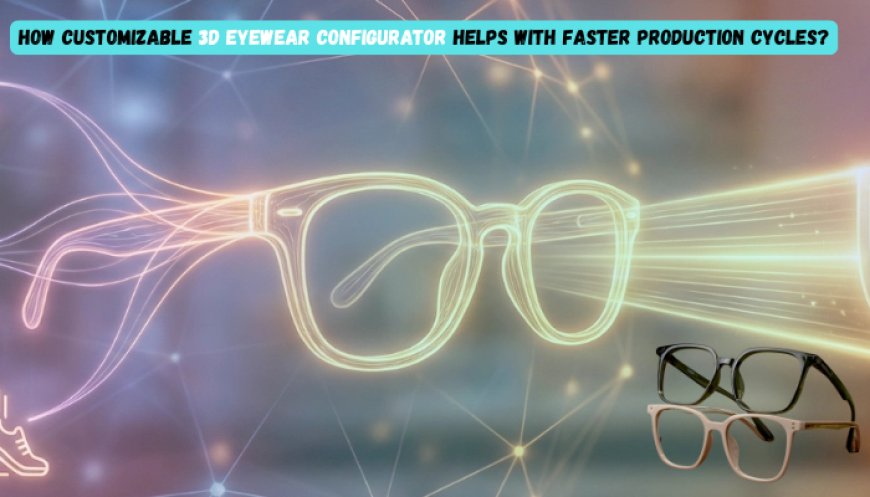
Speed matters in eyewear manufacturing, but speed without accuracy creates waste, delays, and returns. Brands and retailers are under constant pressure to launch more styles, handle customization requests, and shorten delivery timelines all without compromising quality. This is where smart configuration tools quietly change how production flows from concept to finished product.
A customizable configurator connects design decisions directly to manufacturing logic. Instead of passing files back and forth, teams work from a shared, rule-based system that reduces guesswork and manual corrections. When implemented correctly, it reshapes how frames are designed, approved, and produced at scale especially for businesses handling complex personalization.
Below are the most impactful ways this technology accelerates production cycles while keeping quality and consistency intact.
1. Eliminating Manual Design Rework at the Source
One of the biggest causes of production delays is rework. Traditional workflows rely heavily on designers creating variations manually, which are then reviewed, corrected, and often redesigned after feasibility checks.
A configurator prevents this problem by embedding production rules directly into the design stage. Measurements, material constraints, lens compatibility, and finishing options are validated instantly. This allows designers and sales teams to create only manufacturable designs from the start, rather than fixing problems downstream.
When businesses work with 3D Eyewear tools that enforce these rules automatically, the result is fewer rejected designs and a smoother transition into production.
2. Reducing Approval Cycles Between Teams
Approval bottlenecks slow down even the most efficient factories. Designers, engineers, sales teams, and production managers often work in silos, relying on static images or written specifications that leave room for interpretation.
A customizable configurator replaces ambiguity with clarity. Everyone sees the same interactive model, updated in real time as options change. This shared visibility dramatically shortens feedback loops.
Key benefits include:
- Faster sign-off on custom orders
- Fewer clarification emails and meetings
- Clear alignment between design intent and production output
By reducing back-and-forth, companies using 3D Eyewear configurators move from approval to manufacturing without unnecessary delays.
3. Streamlining Custom Orders Without Slowing the Line
Customization is no longer optional, but handling it manually can cripple production speed. The challenge is delivering personalized frames without disrupting standardized workflows.
A configurator solves this by translating customer selections directly into structured production data. Each configuration generates precise specifications that machines and technicians can follow without interpretation.
This approach allows factories to:
- Process high volumes of unique orders
- Maintain consistent production speed
- Avoid setup errors caused by unclear customization requests
Instead of slowing things down, customization becomes a controlled and repeatable processespecially when supported by 3D Eyewear systems designed for manufacturing scalability.
4. Improving Material Planning and Inventory Accuracy
Production delays often start long before manufacturing begins. Inaccurate demand forecasts and poor material planning lead to shortages, overstock, or last-minute procurement.
Configurators provide valuable insight by tracking configuration trends in real time. Businesses can see which materials, colors, and components are selected most often and adjust procurement accordingly.
This data-driven visibility supports:
- Better raw material forecasting
- Reduced excess inventory
- Fewer production stoppages due to missing components
With 3D Eyewear configuration data feeding into planning systems, production teams operate with greater confidence and fewer surprises.
5. Accelerating Prototyping and Sampling Processes
Traditional sampling cycles are slow, expensive, and repetitive. Physical prototypes often need multiple iterations before approval, especially when customization is involved.
A digital configurator reduces reliance on physical samples by providing accurate, production-ready visualizations. Stakeholders can validate proportions, colors, and finishes virtually before committing to tooling or samples.
This shift enables:
- Faster design validation
- Fewer physical prototypes
- Shorter pre-production timelines
By shortening the sampling phase, 3D Eyewear tools help brands move from concept to market with significantly less friction.
6. Supporting Automation and Smart Manufacturing Systems
Modern factories increasingly rely on automation, but automation only works when data is precise and standardized. Configurators generate structured outputs that integrate smoothly with CAD, CAM, and ERP systems.
This seamless data flow reduces manual data entry and lowers the risk of human error. Machines receive exact specifications, and production planning becomes more predictable.
When paired with 3D Eyewear configuration platforms, automation becomes easier to scale and far more reliable across different product lines.
7. Shortening Time-to-Market Without Compromising Quality
Speed means little if quality suffers. The real advantage of a customizable configurator lies in its ability to balance both.
By enforcing design rules, validating options instantly, and connecting design directly to production, brands can launch new collections faster while maintaining consistency. Quality checks happen earlier, not after problems appear on the factory floor.
This structured approach ensures that faster cycles do not lead to higher defect rates or increased returns.
8. Creating a Scalable Foundation for Growth
As businesses grow, manual workflows become harder to manage. What works for a small product range quickly breaks down with expanded catalogs and global distribution.
Configurators offer a scalable foundation that grows with the business. New styles, materials, and rules can be added without rebuilding processes from scratch. Production speed improves not just once, but continuously as systems mature.
For eyewear brands focused on long-term efficiency, this scalability becomes a competitive advantage rather than a technical upgrade.
Why This Matters for Retailers and Manufacturers
Faster production cycles are not just about manufacturing efficiency they directly impact customer satisfaction, revenue, and brand reputation. Shorter lead times mean quicker fulfillment, fewer order cancellations, and better responsiveness to market trends.
A well-implemented Customizable 3D eyewear configurator quietly becomes one of the most valuable tools for eyewear retailers and manufacturers aiming to attract more customers, increase conversions, and reduce costly returns. By aligning customization with production intelligence, businesses can deliver exactly what customers want without slowing down the factory behind the scenes.
If youd like to read more, explore this website for additional blogs and insights-: www.prbusinesswires.com