








Higher Education Market Analysis, Trends & Growth Forecast 2025-2033
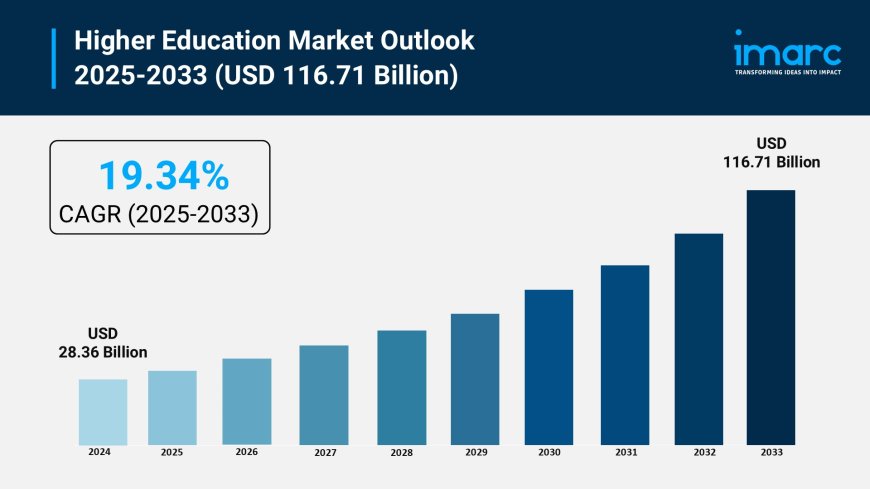
The global higher education market size was valued at USD 28.36 Billion in 2024. Looking forward, IMARC Group estimates the market to reach USD 116.71 Billion by 2033, exhibiting a CAGR of 19.34% from 2025-2033.
Market Overview:
The higher education market is experiencing rapid growth, driven by increased international student mobility, government investment and policy reform, and surge in private sector participation and funding. According to IMARC Group's latest research publication, "Higher Education Market Size, Share, Trends and Forecast by Component, Deployment Mode, Course Type, Learning Type, End User, and Region, 2025-2033?, The global higher education market size was valuedatUSD 28.36 Billionin 2024. Looking forward, IMARC Group estimates the market to reachUSD 116.71 Billionby 2033, exhibiting aCAGR of 19.34%from2025-2033.
This detailed analysis primarily encompasses industry size, business trends, market share, key growth factors, and regional forecasts. The report offers a comprehensive overview and integrates research findings, market assessments, and data from different sources. It also includes pivotal market dynamics like drivers and challenges, while also highlighting growth opportunities, financial insights, technological improvements, emerging trends, and innovations. Besides this, the report provides regional market evaluation, along with a competitive landscape analysis.
Download a sample PDF of this report: https://www.imarcgroup.com/higher-education-market/requestsample
Our report includes:
- Market Dynamics
- Market Trends and Market Outlook
- Competitive Analysis
- Industry Segmentation
- Strategic Recommendations
Growth Factors in the Higher Education Market
- Increased International Student Mobility
The recovery and expansion of international student mobility serve as a primary catalyst for revenue growth in the global higher education sector. In 2024, the United States saw Indian student enrollments rise to 363,000, while Australia recorded approximately 139,000 Indian students across its institutions by late 2025. This movement is not limited to traditional Western hubs; regional education hubs are also expanding. For instance, the number of Higher Education Institutions in India witnessed a 13.8% increase, reaching over 70,600 by mid-2025. Universities are increasingly engaging in transnational education, with the University of Southampton establishing an offshore campus in India to offer degrees equivalent to those in the United Kingdom. This globalization of the student body forces institutions to invest in diverse service offerings, cultural integration programs, and international marketing, which collectively bolsters the financial health and reach of the global education ecosystem.
- Government Investment and Policy Reform
National governments are aggressively funding higher education to drive economic competitiveness and social mobility. In India, the government approved infrastructure expansion for five Indian Institutes of Technology, sanctioning over ?11,800 crore for the period ending in 2029. Additionally, the National Education Policy 2020 has paved the way for programs like the Partnerships for Accelerated Innovation and Research, which pairs top-tier institutions with developing ones to elevate research standards. In the United Kingdom and Europe, scholarship programs, such as the Imperial College of Londons initiative for master's students, are designed to attract global talent in STEM fields. Furthermore, many countries are incentivizing vocational and technical education to bridge the gap between academia and industry. These state-led initiatives provide the necessary capital for physical and digital infrastructure, creating a stable environment for institutions to expand their capacity and modernize their pedagogical approaches.
- Surge in Private Sector Participation and Funding
The private sector's role in higher education has expanded significantly, with private institutions now holding a major revenue share of approximately 57% globally. This growth is fueled by massive investments in educational technology and alternative funding models. For example, the Dutch EdTech provider Lepaya recently raised 36 million to enhance AI-based corporate learning for multinational firms. In India, Propelld launched a loan scheme offering up to ?50 lakhs for students studying abroad, addressing the growing demand for accessible financing. Beyond direct tuition, revenue is increasingly derived from grants, contracts, and private gifts, a segment that is expanding faster than traditional sources. Companies are also collaborating with universities to co-design curricula, ensuring that the 51.3% of students now considered "job-ready" in emerging markets have skills that align with current market demands. This private-public synergy ensures a continuous flow of capital and innovation.
Key Trends in the Higher Education Market
- AI-Driven Personalized Learning
Artificial Intelligence is no longer a futuristic concept but a core component of the higher education experience. Institutions are utilizing machine learning algorithms to create hyper-personalized learning paths that adapt to an individual student's pace and style. Platforms like Coursera and edX employ these tools to suggest specific content and assess progress in real-time. Beyond academics, AI-powered virtual assistants, such as "Pounce" at Georgia State University, assist students with complex administrative tasks like financial aid applications and course selection. These systems can even identify at-risk students by analyzing attendance and engagement data, allowing for proactive intervention. By automating routine inquiries and tailoring educational materials, universities are significantly improving retention rates and student satisfaction, making the learning process more efficient and responsive to the needs of a diverse and global student population.
- Shift Toward Alternative Credentials
There is a growing trend where students and employers prioritize short-term, skill-based certifications over traditional four-year degrees. Recent data indicates that 54% of prospective students are now more likely to consider a professional certificate or "bootcamp" program than a full degree. This shift is driven by the immediate need for upskilling in rapidly changing industries like data science and renewable energy. Universities are responding by offering "micro-credentials" and stackable units of learning that can eventually lead to a full qualification. In 2024, the number of online learners surpassed 1.5 billion, many of whom are pursuing these alternative pathways for their flexibility and lower cost. This trend reflects a broader move toward lifelong learning, where education is viewed as a continuous process of skill acquisition rather than a one-time event completed in early adulthood.
- Integration of Immersive Technologies
Virtual Reality (VR) and Augmented Reality (AR) are transforming the physical and digital boundaries of the campus. Universities are now using these technologies for everything from virtual campus tours for prospective international students to high-stakes medical training. For instance, Case Western Reserve University utilizes the Microsoft HoloLens to allow anatomy students to interact with 3D models, providing a level of detail impossible with traditional textbooks. Similarly, Labster provides virtual laboratories where students can conduct STEM experiments without the safety risks or costs associated with physical labs. These immersive experiences are also being used to create "living labs" on campus, where students analyze real-time data from smart building systems to learn about sustainability and energy management. By merging the digital and physical worlds, institutions are providing highly engaging, hands-on experiences that better prepare students for the technical demands of the modern workforce.
Our report provides a deep dive into the higher education market analysis, outlining the current trends, underlying market demand, and growth trajectories.
Leading Companies Operating in the Global Higher Education Industry:
- Anthology Inc.
- Blackbaud Inc.
- Cisco Systems Inc.
- Dell Technologies Inc.
- Ellucian Company L.P.
- Instructure Inc.
- Oracle Corporation
- Pearson plc
- SAP SE
- ServiceNow Inc.
- Verizon Communications Inc.
- VMware Inc.
- Xerox Corporation
Higher Education Market Report Segmentation:
By Component:
- Solutions
- Student Information Management System
- Content Collaboration
- Data Security and Compliance
- Campus Management
- Others
- Services
- Managed Services
- Professional Services
Solutions account for the majority of shares due to their integrated approach combining various technologies and customizable features for institutions.
By Deployment Mode:
- On-premises
- Cloud-based
Cloud-based dominates the market by eliminating hardware needs and enabling flexible access to educational resources from any device.
By Course Type:
- Arts
- Economics
- Engineering
- Law
- Science
- Others
Arts leads the market by appealing to broader student populations with diverse interests and emphasizing critical thinking and creativity.
By Learning Type:
- Online
- Offline
Offline learning dominates due to direct student-educator interaction, hands-on practical work, and established institutional reputations.
By End User:
- State Universities
- Community Colleges
- Private Colleges
State universities enjoy the leading position owing to affordable tuition, government subsidies, and widespread geographical presence.
Regional Insights:
- North America (United States, Canada)
- Asia Pacific (China, Japan, India, South Korea, Australia, Indonesia, Others)
- Europe (Germany, France, United Kingdom, Italy, Spain, Russia, Others)
- Latin America (Brazil, Mexico, Others)
- Middle East and Africa
North America enjoys the leading position owing to prestigious institutions, advanced research funding, and significant international student enrollment.
Note: If you require specific details, data, or insights that are not currently included in the scope of this report, we are happy to accommodate your request. As part of our customization service, we will gather and provide the additional information you need, tailored to your specific requirements. Please let us know your exact needs, and we will ensure the report is updated accordingly to meet your expectations.
About Us:
IMARC Group is a global management consulting firm that helps the worlds most ambitious changemakers to create a lasting impact. The company provide a comprehensive suite of market entry and expansion services. IMARC offerings include thorough market assessment, feasibility studies, company incorporation assistance, factory setup support, regulatory approvals and licensing navigation, branding, marketing and sales strategies, competitive landscape and benchmarking analyses, pricing and cost research, and procurement research.
Contact Us:
IMARC Group
134 N 4th St. Brooklyn, NY 11249, USA
Email: sales@imarcgroup.com
Tel No:(D) +91 120 433 0800
United States: +1-201971-6302