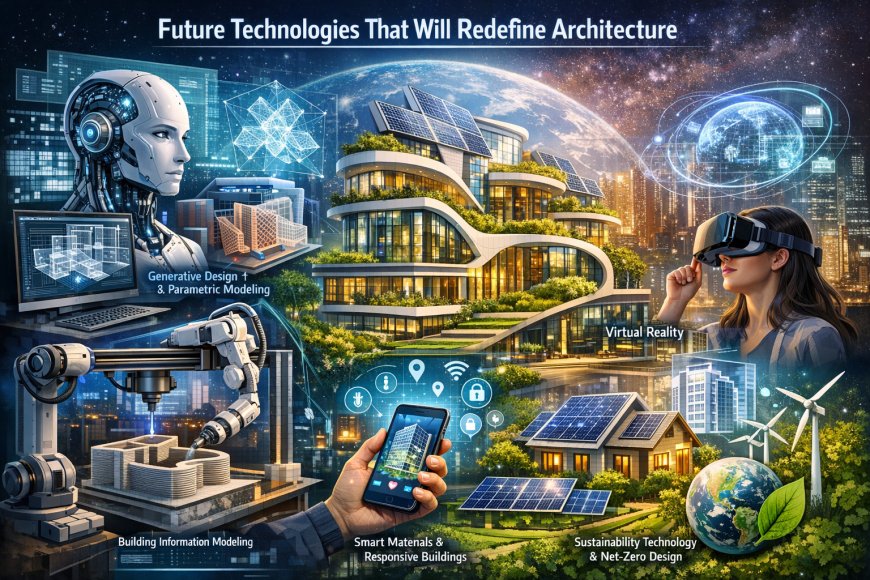
Architecture has always evolved alongside technology. From hand-drawn blueprints to CAD software, each innovation has reshaped how buildings are imagined and constructed. Today, the industry is entering another major shift. Emerging technologies are no longer just supporting architectural work; they are redefining how spaces are designed, built, and experienced. For cities growing rapidly and demanding smarter infrastructure, these changes are setting new expectations for architects, developers, and clients alikeincluding those working with the Top Architects in Chennai, where urban density and innovation increasingly go hand in hand.
Artificial Intelligence in Architectural Design
Artificial Intelligence (AI) is transforming architecture from a linear design process into a data-driven one. AI-powered tools can analyze thousands of design possibilities in minutes, helping architects choose layouts that optimize light, airflow, energy efficiency, and space usage. Instead of relying only on intuition and precedent, architects can now base decisions on predictive outcomes.
AI also assists in feasibility studies, zoning analysis, and cost estimation. By learning from past projects, AI systems can flag potential design flaws early, reducing rework during construction. As these tools mature, architects will spend less time on repetitive tasks and more time on creative and strategic thinking.
Generative Design and Parametric Modeling
Generative design takes AI a step further by allowing architects to define goals and constraintssuch as materials, budget, site size, or environmental conditionswhile the software generates multiple design options. This approach is especially valuable for complex urban projects where space is limited and performance requirements are high.
Parametric modeling supports this process by enabling dynamic designs where changing one parameter automatically updates the entire model. This allows architects to test variations quickly and adapt designs to real-world conditions, making buildings more responsive to their surroundings.
Building Information Modeling (BIM) as a Central Nervous System
While BIM is already widely used, its role is expanding from documentation to full lifecycle management. Advanced BIM platforms now integrate architecture, structure, MEP systems, sustainability data, and maintenance planning into a single ecosystem.
Future BIM systems will connect directly with construction equipment, facility management software, and smart building systems. This seamless data flow reduces errors, improves collaboration, and ensures buildings perform as intended long after completion. For large-scale developments, BIM is becoming the backbone of efficient and transparent project delivery.
Smart Materials and Responsive Buildings
Material innovation is redefining what buildings can do. Smart materials can respond to environmental changes such as temperature, light, or humidity. Examples include self-healing concrete, electrochromic glass that adjusts transparency, and phase-change materials that regulate indoor temperatures.
These technologies reduce energy consumption while improving occupant comfort. Over time, responsive materials will allow buildings to adapt in real time, making architecture more resilient and sustainable in changing climates.
Internet of Things (IoT) and Smart Buildings
The integration of IoT is turning buildings into intelligent systems. Sensors embedded throughout a structure collect data on occupancy, energy use, air quality, and maintenance needs. This information helps building managers optimize performance and reduce operational costs.
From automated lighting and climate control to predictive maintenance, IoT-driven architecture prioritizes efficiency and user experience. As urban populations grow, smart buildings will play a critical role in managing resources responsibly.
Virtual Reality (VR) and Augmented Reality (AR)
VR and AR are changing how architects communicate ideas. Clients can now walk through a building before construction begins, understanding scale, flow, and design intent more clearly. This reduces misunderstandings and costly design changes later in the process.
On construction sites, AR overlays digital models onto physical spaces, helping teams visualize installations accurately. These technologies bridge the gap between design and execution, improving accuracy and collaboration.
3D Printing and Advanced Construction Technologies
3D printing is no longer experimental. Architects and engineers are using large-scale printers to create building componentsand in some cases, entire structureswith minimal waste. This technology allows for complex geometries that would be expensive or impossible using traditional methods.
Alongside modular construction and prefabrication, 3D printing accelerates project timelines and improves quality control. These methods are especially relevant in fast-growing urban areas where speed and efficiency are essential.
Sustainability Technology and Net-Zero Design
Sustainability is becoming a core design requirement rather than an optional feature. Future technologies enable precise energy modeling, daylight simulation, and carbon footprint analysis at early design stages.
Renewable energy integration, smart grids, rainwater harvesting systems, and passive design strategies are now supported by advanced software tools. Architects can design net-zero and even energy-positive buildings that align environmental responsibility with long-term economic value.
Data-Driven Urban Planning
At the city scale, big data and analytics are reshaping urban design. Architects can analyze traffic patterns, population density, environmental risks, and social behavior to create more livable urban spaces.
This approach supports smarter zoning, improved public spaces, and infrastructure that adapts to real human needs. As cities become more complex, data-driven architecture will be essential for sustainable urban growth.
The Human Role in a High-Tech Future
Despite rapid technological advancement, architecture remains deeply human. Technology enhances decision-making, but it cannot replace cultural understanding, empathy, and creativity. The architects who will thrive are those who balance innovation with contextdesigning spaces that are not only efficient but meaningful.
The future of architecture belongs to professionals who can integrate technology thoughtfully while maintaining a strong design philosophy. This balance is already visible in the work of the Top Architects in Chennai, where tradition, climate, and modern technology intersect.
Conclusion
Future technologies are redefining architecture from concept to completion. AI, generative design, smart materials, BIM, and immersive visualization tools are changing how buildings are designed, built, and experienced. As these innovations become standard practice, architects must continuously adapt and learn.
Those who embrace technology as a design partner rather than a replacement will lead the next era of architecture. By combining advanced tools with human insight, the Top Architects in Chennai and beyond are shaping smarter, more sustainable, and more responsive built environments for the future.